
If 2023–24 was the “playground” phase for GenAI in legal services, 2025 felt like the year things had to grow up.
Across the market, we’ve seen law firms move from experimentation to evaluation: fewer “try this cool demo” moments and more structured questions about risk, value, and fit. At Clarilis, that’s been mirrored in our own journey - from articulating principles, to building evaluation frameworks, to launching Clarilis AI Draft.
Looking back at 2025, five themes illustrate how our thinking about AI legal drafting has evolved, and where we see it heading in 2026.
Lesson 1: Start from your precedents, not from the model
Early on, one thing became very clear (10 principles shaping the role of GenAI in legal drafting): however powerful large language models become, they are not a substitute for high-quality precedents. Our simple starting point is:
Precedents crafted by experienced knowledge lawyers are still the gold standard.
That thinking underpins how we’ve approached Clarilis AI Draft. We don’t ask GenAI to do what automation already does extremely well. Instead, we use automation to do the heavy lifting based on signed-off precedents, and bring GenAI in where those precedents run out of road.
Lesson 2: “What does good look like?” beats “Does it sound clever?”
Anyone who has spent time with AI drafting tools will recognise the temptation to judge them by feel: this clause sounds pretty good, that note of advice looks plausible.
The problem is that this is often a terrible way to make decisions.
Evaluation is so hard in a GenAI context because (Evaluating AI: What about drafting tools?):
- Outputs vary, even with the same inputs.
- Inputs are open-ended and hard to exhaustively test.
- Outputs are unstructured and usually require expert judgement to assess.
Our answer is to move away from “vibes-based” testing and towards a more structured question: what does good look like for this specific task?
You can still use simple dimensions like relevance, accuracy, and completeness, but grounding those dimensions in a concrete expectation makes evaluation more objective and more comparable across tools.
We also explored how AI can help with this evaluation (the “snake eating its tail”). Used carefully, AI can mark outputs against a human-designed rubric at scale. It isn’t a replacement for expert review, but it can quickly highlight patterns and areas for human focus.
Lesson 3: AI should close the last 10%, not rewrite the first 90%
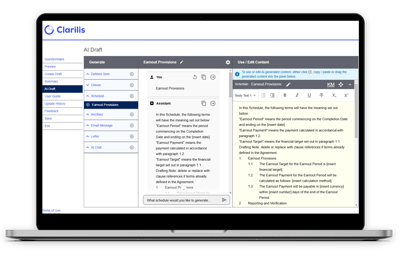
Our core automation technology has always focused on turning market-standard content into intelligent, rules-based precedents. That approach already helps lawyers produce first drafts that are ~90% complete in minutes.
The question we asked when designing Clarilis AI Draft was: can AI help with the remaining 10%? (How Clarilis AI Draft is closing the gap in legal drafting).
In practice, that meant focusing AI Draft on tasks like:
- Drafting bespoke deal-specific clauses that fall outside the automated precedent.
- Proposing new defined terms and inserting them in the right place with the right formatting.
- Producing ancillary documents or emails that support the main transaction.
Significantly, AI Draft doesn’t behave like a general-purpose chatbot. It’s tuned to legal drafting tasks and to specific practice areas. The expectations around a real estate process agent clause, an M&A open-source software warranty, or an early-stage investment shareholder waiver are very different. And AI Draft is configured accordingly, with deep insight from our knowledge lawyers.
Lesson 4: RAG helps with trust, but it doesn’t replace judgement
One of the biggest barriers to adopting GenAI in legal contexts is trust (Bridging the trust gap: RAG and AI drafting). High-profile examples of hallucinated citations and outdated references have understandably made lawyers wary.
At a high level, RAG can deliver:
- Better relevance: outputs are aligned with firm-specific standards and the right jurisdiction.
- Improved transparency: it’s easier to see which sources informed the answer.
- Fewer hallucinations: the model is less likely to guess when it has concrete material to work from.
But we also need to be clear about the limitations:
- RAG is only as good as the content you retrieve and the way you retrieve it. Poor-quality drafts, un-curated deal bibles, and counterparty documents make for unreliable inputs.
- Retrieval in law is complex. Simple vector search is rarely enough; you often need to incorporate metadata, document types, approval status, and wider drafting context.
- Even with excellent sources, the model can still misinterpret or over-generalise. It’s generating language, not proving a theorem.
Sometimes, the best thing an AI-enabled system can do is not to generate anything new at all – just to surface the right precedent quickly and let the lawyer decide how to use it.
Lesson 5: The most important input is still a good lawyer
Across these themes, lawyers retain a critical role in every stage of AI drafting (Why GenAI still needs a good lawyer).
Looking at our own development process, three roles that have been particularly important:
- Identifying the right problems to solve
Lawyers help distinguish between tasks where GenAI adds real value and tasks better served by traditional automation or by human judgement alone. For us, that meant focusing AI Draft on the parts of the drafting process that precedents and automation can’t easily cover. - Tailoring tools to specific practice areas
The format, tone, and content expectations in M&A, real estate, and early-stage investment work are very different. Embedding practice-specific expertise into prompts, examples, and evaluation is what turns a generic model into a genuinely useful drafting tool. - Integrating AI into real workflows
Even the best-designed drafting feature fails if it elongates review or introduces uncertainty about who needs to do what next. Legal user feedback has been essential in ensuring that AI Draft fits alongside existing review and sign-off processes, rather than disrupting them.
We’ve also seen that lawyer involvement doesn’t end at launch. As models, regulations, and firm policies evolve, ongoing input from practitioners and knowledge lawyers is essential to keep tools relevant and safe.
Closing thoughts
In 2026, we expect the questions to shift even more from “can AI do this?” to “how do we operationalise this safely and at scale?” Our plan is to keep refining AI Draft and to keep listening to how our customers are using (and challenging) these tools in real matters.
If you’re interested in comparing notes on any of the themes above, we’d love to hear from you.
Clarilis automations help lawyers produce first drafts that are 90% complete in minutes. But they don't always capture every scenario or deal-specific nuance. Clarilis' AI Draft can close that 10% gap.

Subscribe to blog
To stay up to date with all the latest news and insights, enter your email address.
(Privacy policy)